

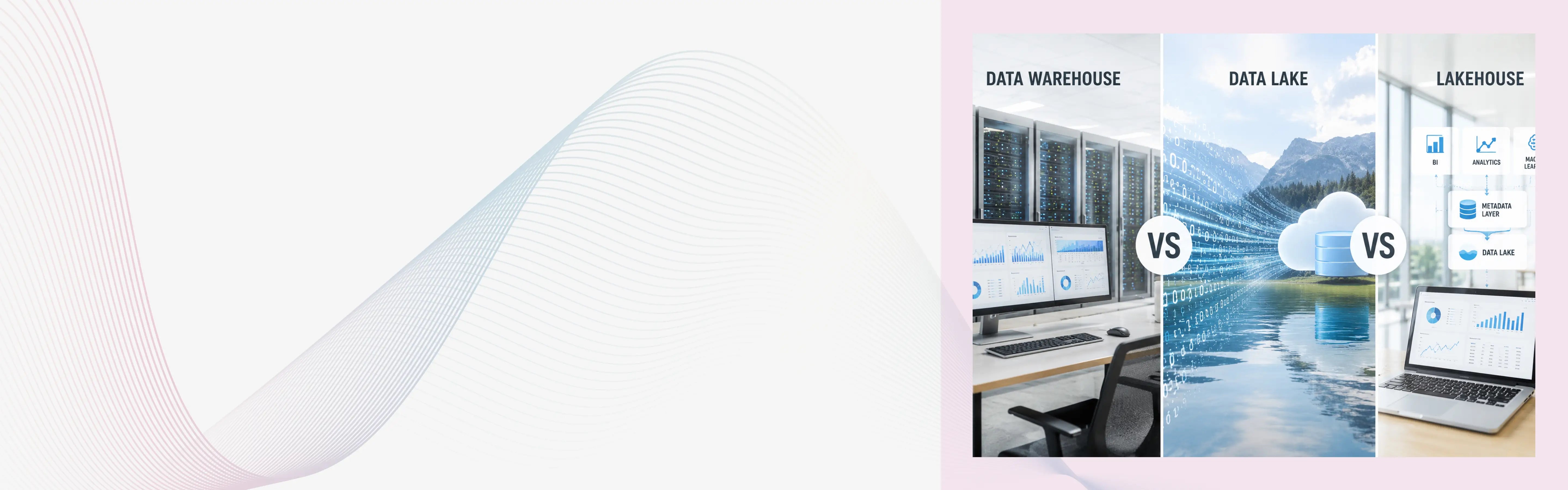
The practical difference between a data lake and a data warehouse is how data becomes ready to use. A lake gives you a flexible place to retain source data. A warehouse gives analysts a managed environment for querying analytical tables. A lakehouse brings transactional table management to lake-based storage, allowing those roles to overlap.
These are architecture patterns, not mutually exclusive product categories. Modern warehouses can handle JSON and streaming ingestion, while lakehouse platforms can serve SQL dashboards. Start with the workload you need to support, then check the specific platform's capabilities.
Data lake vs data warehouse vs Lakehouse at a glance
| Decision area | Data lake | Data warehouse | Data lakehouse |
|---|---|---|---|
| Main role | Retain source data for processing, exploration, and reuse | Serve managed analytical tables for reporting and analysis | Support analytical workloads over transactionally managed lake tables |
| Data formats | Files and objects in varied formats | Structured tables, with semi-structured support in modern products | Managed tables plus other files in the underlying storage environment |
| Schema | Can land source data before defining analytical models | Curated tables have explicit schemas; landing data can be more flexible | Managed tables enforce schemas, with evolution depending on the format and engine |
| Querying | Requires a compatible query or processing engine | SQL is the main interface for analytical work | SQL and other processing interfaces, depending on the implementation |
| Performance factors | File layout, metadata, pruning, and the query engine | Data models, execution resources, and concurrent queries | Table layout, engine capabilities, maintenance, and concurrent workloads |
| Transactions | Object storage alone is not a transactional analytical table | Database transactions, with scope determined by the platform | Atomic table commits and concurrency controls; broader guarantees depend on the implementation |
| Governance | Requires deliberate cataloging, permissions, ownership, and quality controls | Managed controls still require configuration and accountable owners | Catalog and governance services must be configured across engines and assets |
| Cost to evaluate | Storage plus the work needed to process and serve it | Storage, ingestion, transformation, and query compute | Storage, compute, table maintenance, catalog services, and operations |
| Strong starting point | Raw retention, exploration, and reusable source history | SQL-led reporting and governed business metrics | Mixed data engineering, SQL analytics, and machine-learning workflows |
| Main caution | Stored data is not necessarily documented or analysis-ready | A product's analytical capabilities may not fit every processing workflow | Open formats do not remove operational work or compatibility limits |
This table describes typical roles, not restrictions that apply to every product. IBM's architecture comparison explains how these patterns coexist; the product documentation below identifies important exceptions to older lake-versus-warehouse comparisons.
What is the difference between a data lake and a data warehouse?
A data lake preserves data before every use is known
A data lake holds data in files or objects, often in cloud object storage. It can retain structured exports, JSON events, logs, images, and other source material. Teams can keep that material before deciding how each downstream analytical dataset should be modeled.
For example, an application might retain its original event payloads in a lake while analysts use only a small selection of fields. That retained history can support a later processing requirement. This is an illustrative design choice, not a claim that every organization needs to retain every event indefinitely. The responsibility is to make the retained data understandable and safe to use. Define ownership, access permissions, retention rules, and quality checks alongside ingestion. A storage location without those controls is not an analytical product.
Best fit: Teams that need reusable source history or varied files for processing and exploration.
Ask about: Who owns each dataset, how long it must be retained, and which engine will make it usable?
A data warehouse serves analytical tables
A data warehouse (DWH) brings data into an environment designed for analytical queries, reporting, and business intelligence. Its curated tables provide a consistent structure for questions such as revenue by region or inventory movement over time.
That does not mean modern warehouses accept only rigid, preprocessed relational data. Snowflake supports structured and semi-structured data, and BigQuery has a native JSON data type. BigQuery also supports both extract-transform-load (ETL) and extract-load-transform (ELT), so transformation does not always have to happen before loading.
For a SQL-focused team, the useful question is whether the warehouse can deliver the required models, permissions, freshness, and query behavior without unnecessary platform complexity.
Best fit: Teams whose main deliverables are governed SQL datasets, dashboards, and reporting.
Ask about: Can the platform meet representative query and concurrency requirements within the operating budget?
Schema-on-read vs schema-on-write is a useful starting point, not a hard boundary
Schema-on-read means applying structure when reading data. Schema-on-write means validating it against an expected structure as it is written. Lakes are commonly associated with the former and warehouses with the latter.
In practice, a warehouse can load flexible JSON payloads before producing curated tables. A lakehouse can retain raw files while enforcing schemas on managed tables. Separate the requirements for raw landing data from the requirements for trusted reporting datasets.
What is a data lakehouse?
A data lakehouse is an architecture that combines lake-based storage with capabilities associated with managed analytical tables, including transactions, schema management, and query access. Open table formats such as Apache Iceberg and Delta Lake are important components, but a table format alone is not a complete data platform.
A useful way to understand lakehouse architecture is to separate its responsibilities:
- Storage: Where source files and analytical data files live.
- Table management: Which files belong to a committed table version and how changes become visible.
- Compute: Which engines ingest, transform, train models, and execute analytical queries.
- Governance and serving: How users discover data, gain access, trace its origin, and consume approved datasets.
These responsibilities can be provided by one managed platform or assembled across services. Evaluate the resulting system, including its maintenance work, rather than treating the presence of Delta or Iceberg as proof that the architecture is complete.
What transactional tables do, and what they do not do
Iceberg uses atomic table updates and snapshots to give readers a consistent table state. Delta Lake uses optimistic concurrency control: a conflicting write can fail with a concurrent modification exception instead of corrupting the table. Transactional does not mean that concurrent operations can never conflict.
Check the transaction boundary explicitly. Atomic updates to one table do not, by themselves, establish that a pipeline updating several tables is atomic. Some platforms offer broader transaction capabilities, so this requires a product-specific check rather than a blanket claim about all lakehouses.[41][29] Lakehouse layers also do not mean there is literally one identical dataset for every user. In a medallion design, Bronze retains source data, Silver contains validated data, and Gold serves business-oriented models and aggregates. Those are different representations with different purposes and update paths.
Best fit: Teams that need SQL analytics and other processing workloads over shared, managed lake tables.
Ask about: Which engines support the required table features, who operates the platform, and what transaction guarantees apply?
Data Lakehouse vs data Warehouse: implementation comparison
The distinction is less clear than older comparison charts suggest. Snowflake separates storage and compute and supports Apache Iceberg tables. Microsoft Fabric Warehouse stores data in open Delta tables. A warehouse is not automatically closed-format or tightly coupled.
Microsoft's own Fabric decision guide illustrates why implementation details matter. It distinguishes a T-SQL-led Warehouse with multi-table transaction support from a Lakehouse suited to Spark-based data engineering. The Lakehouse's SQL analytics endpoint provides read-only querying of its Delta tables, rather than the same write capabilities as Warehouse.
Use that distinction when comparing products. Ask whether your team needs SQL-based data modification, notebook-based processing, multi-table transactions, or access through particular engines. Two products can share an underlying format while offering different development and operating experiences.
Streaming is not exclusive to a lakehouse, either. BigQuery's Storage Write API supports real-time ingestion. Check ingestion latency and downstream transformation behavior separately; a streaming entry point does not establish when a dashboard will contain validated results.
When should you use a data lake vs a data warehouse?
Choose a warehouse when reporting is the main job
Start with a warehouse when the primary requirements are curated SQL models, scheduled reporting, and shared business metrics. The architectural goal is to make trusted analytical datasets easy for the intended users to consume.
For an existing warehouse, first investigate the actual constraint. A slow report, unclear ownership, or an inefficient transformation is not enough evidence to justify a platform migration. Test whether a targeted change can solve the problem before adding another system.
Choose a lake when retention and flexible processing come first
Start with a lake when retaining original source data has a defined purpose and the processing requirements vary. Examples include keeping event history for later analysis or storing files that do not belong in a conventional reporting table.
Do not present raw storage as the finished solution when users need daily dashboards. Specify the processing, cataloging, and serving components that will turn files into the datasets those users need.
Evaluate a lakehouse when the workloads justify a shared table layer
A lakehouse is worth evaluating when SQL analysts and data engineers need to work across related datasets and maintaining separate environments creates measurable delivery or operating problems. Its value should be demonstrated in those workflows, not inferred from a market forecast.
Do not migrate solely because the lakehouse is newer. If a warehouse meets the service requirements and the proposed architecture cannot demonstrate a worthwhile improvement, keeping it is a reasonable decision. A lake can also remain alongside a warehouse when each has a clear role.
Data lake vs data warehouse cost: what should you compare?
Compare the cost of delivering the same usable outcome, not just storing the same number of bytes. Snowflake, for example, separates storage and compute. A warehouse's cost cannot be explained by assuming those resources are always coupled.
Use this worksheet when evaluating candidates. It is a planning framework, not a claim that one architecture is always cheaper.
| Cost area | Questions for the evaluation |
|---|---|
| Storage and retention | What must remain raw, curated, replicated, or recoverable? How long is each representation needed? |
| Ingestion | What does it cost to load, validate, and replay the required data? |
| Transformation | How much processing is needed to produce the same approved datasets? |
| Query serving | What resources are needed at expected concurrency, including peak periods? |
| Maintenance and governance | Who handles permissions, cataloging, table maintenance, monitoring, and incidents? |
| Migration | What must be rebuilt, reconciled, and operated in parallel before cutover? |
Also test the assumptions behind query cost. A file-based lake does not necessarily scan every file in full. Parquet provides statistics and optional page indexes, and Spark supports Parquet filter pushdown. Compatible readers can skip irrelevant data, although the benefit depends on file layout, metadata, predicates, and engine support.
For a fair comparison, use equivalent data, query results, retention requirements, and freshness targets. Record warm and cold runs separately and include the resources needed to keep each option operating. Treat the findings as evidence for your workload, not a universal benchmark.
How to choose: write a workload decision before a migration plan
Use the following framework as an evaluation method. Its purpose is to expose requirements that a definitions-only comparison can miss.
1. Define the output and the freshness requirement
Name the datasets, reports, or models the platform must deliver. For each, specify what "ready" means: ingested, validated, transformed, or visible to the user. Assign an owner who can confirm the result is correct.
2. Identify the users and the work they actually do
List the critical SQL queries, transformations, and model-development tasks. Check the team's skills and the tools already connected to the platform. Do not choose an architecture on the assumption that users will adopt a new interface without support.
3. Test the difficult updates, not just the first load
Include source-schema changes, late data, deletions, replay, and concurrent writes in the evaluation. Require a demonstrated recovery path. A platform that loads a sample successfully has not yet shown that it can operate the production workflow.
4. Check governance across the complete path
Follow a dataset from source to consumption. Confirm who can access raw data, which quality checks create the approved version, and how downstream users learn about failures. Do not equate schema validation with proof that business values are correct.
5. Compare the complete operating cost
Use the worksheet above and record the assumptions behind each estimate. Include engineering work and parallel operation during migration. If an option saves query compute but creates additional maintenance, make that trade-off visible.
6. Make the smallest decision supported by the results
The outcome might be to keep the warehouse, add a raw retention layer, introduce managed lake tables for one workload, or migrate in phases. Choose the scope the evidence supports. Avoid turning a specific processing problem into a company-wide replacement project.
A useful decision record contains the workload, acceptance criteria, alternatives tested, observed limitations, operating owner, and cutover or rollback conditions. That gives the team a reason for the choice that can be revisited when requirements change.
Our project example: a phased move for mixed workloads
Lucent Innovation's published retail subscription platform case study describes a business where Snowflake already supported analytics. As the business grew, the team wanted to bring analytics, machine learning, and operational-data workflows into a more connected environment, including fresher information for logistics.
The reported approach was a phased move to Databricks, with source data entering Bronze, cleaned data moving through Silver, and business-ready datasets prepared in Gold. This illustrates how raw records, validated datasets, and reporting models can serve different needs within one lakehouse.
The decision lesson is specific: evaluate the work involved in supporting related workloads across environments. This case does not establish that Snowflake cannot support machine learning or that another company will benefit from the same migration.
Lucent Innovation provides data engineering and Databricks services. This example is drawn from Lucent's published project account, not an independently controlled platform benchmark.
Data lake vs warehouse vs database: where does each fit?
In this comparison, an operational database supports an application's day-to-day activity, such as creating an order or updating inventory. A warehouse supports analytical questions across records and time. A lake retains source material for processing and reuse. These roles can work together rather than replace one another.
For example, a commerce application can keep order processing in its operational database while sending data downstream for analysis. Moving reporting to a lakehouse does not, by itself, replace the application's transactional database. Product capabilities can overlap, so evaluate the specific transaction and latency requirements.
Data warehouse vs data mart
A data mart is an analytical store focused on a department, subject, or business unit. A warehouse has a broader organizational scope. A finance mart might expose approved financial datasets without requiring every finance user to navigate the entire enterprise warehouse.
Data mart vs data warehouse is therefore mainly a scope and consumption question. It is not a separate answer to whether source data should land in a lake, nor does it require adopting a lakehouse.
Planning a data-platform change?
Start with the workloads that are failing their requirements and the constraints a replacement must meet. Lucent Innovation's data engineering services can help assess the current platform, evaluate alternatives, and plan a phased change where the evidence supports one.


